
Studio Theatre, Ashley Road Salisbury
Tickets: Salisbury Information Centre, Fish Row, Salisbury Phone: 01722 342860 or from www.ticketsource.co.uk/studiotheatresalisbury
Reviews – Dracula!
Read the reviews of our May 2025 production of Dracula below.
WHAT is it about the story of Dracula that continues to grip us? Whether it is the 1897 original Bram Stoker novel, the high camp of Hammer horror movies, the dark charisma of the Mark Bruce Dance Company version or any of the stage adaptations, this gothic tale exerts a peculiar fascination.
One answer, suggested by Count Dracula himself in Richard M Sharpe’s 1980 play, is that ordinary men do not understand women, their power, their intelligence and their independent spirit. Perhaps there was more than a little truth in this, if you consider the doll-like model of perfect young womanhood in the late Victorian period in which Stoker lived and wrote. The tragic figure of Lucy Westenra, the Count’s first victim in this version and already dead as the play opens, is the Victorian male’s “ideal” – beautiful, flirtatious, superficially subservient. He friend, the brave, intelligent Mina, is a very different and much more “modern” young woman.
Studio Theatre chose Sharpe’s retelling of the story of the Transylvanian nobleman, doomed to live forever, periodically rejuvenated by the blood of a beautiful young woman – a shadowy figure of unimaginable psychological and physical power, living in the shadows and hiding during daylight hours.
From his first entry, to greet the hapless Jonathan Harker (Matthew Hodge), Paul Chambers inhabits the central role with real presence, his Gandalf-like long grey hair framing his intelligent but inscrutable face, a sophisticated host but a ruthless master, sending his (undead) female protégées scuttling back to their quarters, ready to feast on a new-born baby.
For the story of Dracula to work, you have to believe in the forcefield of charisma around the central figure. You don’t have to believe in the idea of the undead, or even know about the Count’s legendary ancestor, the monstrous tyrant Count Vlad “the Impaler.” You have to accept the premise that this bestial creature, who sinks his lascivious teeth into the slender throat of a sleeping woman, draws the victim to him as he sucks out her life-blood. It’s a chillingly powerful metaphor for male supremacy!
Sharpe’s version plays the story straight – there are no laughs, no moments of high camp glamour or silliness. This is a tale of good versus evil, of the battle between a figure of ancestral, superhuman power and people of faith and courage. As such, it is timeless.
The play also brings much more to the fore the role of the pathetic Renfield (a marvellously twitchy, jumpy performance by Simon Haseley). Here the madman is a creature utterly subject to Dracula’s power, but an inner core of humanity lurks within, well-depicted in this characterisation.
As the two young women, close friends but very different in character, Martha-Rose McKeown captures the flighty charm and tragic destiny of Lucy, while Martha Osment, returning to Studio Theatre after a nine-year hiatus, is convincing as the brave, intelligent and independent Mina.
Matthew Hodge’s Harker is a sensible young man, caught up in a web of cruelty, corruption and evil beyond his Victorian middle class comprehension. His friend, and Lucy’s fiancé, Dr John Seward (Andrew Hall, capturing the torment of a professional scientist drawn into a supernatural underworld), is trying to bring more compassionate treatment to people considered insane – but forced to confront the impossible reality of Dracula.
Central to the struggle to destroy the Count is the rather mysterious Dr van Helsing, a man of science and learning, whose deep Christian faith allows him to grapple with the challenge of true evil. Alistair Faulkner, maintaining a credible Dutch accent throughout, captures the intelligence and strength of this pivotal character.
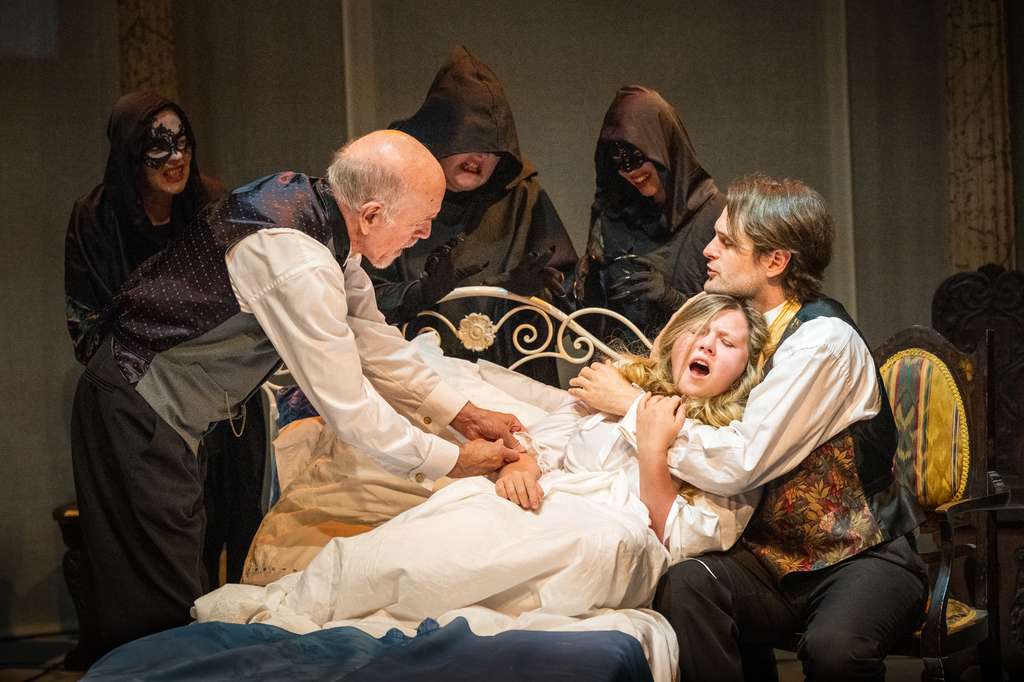
Whether they are Sharpe’s creation, or director Linda Hayman’s idea, the presence of six black-clad figures with claw-like hands and making weird bird-like noises, provides a constant on-stage presence, as harbingers of death, Dracula’s henchmen – and stage furniture-movers. These are the Nosferatu – apparently an ancient Romanian word for vampire.
They are a fearful and atmospheric presence. If there is a criticism of this richly visual and dramatic production, it is that the scene-changing is quite slow, albeit accompanied by well-chosen music. But that slowness creates its own tension, contributing to the almost hypnotic power of the story.
Congratulations to everyone involved in this darkly enjoyable show, including the atmospheric back-projections and the splendid costumes.
FC
https://www.theftr.co.uk/dracula-studio-theatre-salisbury/
With a multitude of renditions and a myriad of lore and traditions, who hasn’t heard of Dracula? In one of the most faithful versions of Bram Stoker’s gothic horror novel, Studio Theatre’s latest sell-out production continues to prove the lure of his enduring appeal.
Director Linda Hayman brought her passion and directorial expertise for the classics to Dracula’s timeless story, here adapted by Richard Sharpe. It’s a novel noir of desire, yearning, seduction and immorality, which resulted in a totally beguiling evening full of intense intrigue and horror. From the moment I entered the auditorium, greeted by the illuminated dead body of a young woman dressed in pure white, I was drawn into the dark and twisted underworld of the Count’s domain – and remained gripped in its spell throughout.
As the lights – with musical accompaniment – came up ever so slowly, the atmosphere genuinely built into inevitable tension. The voiceovers (in a cinematic touch) served to introduce each character in turn, as the characters honoured the recently deceased young lady. I did feel that the continuation of underlying music would have brought even more depth to the staging (I think it only happened once), but that really is being pernickety! Generally speaking, the pace and timing throughout were first rate.
Colin Hayman’s deceptively simple set of gothic columns, cloths and set pieces was brilliantly enhanced with projected images, helping to clearly establish each location (Whitby, London and Dracula’s Transylvanian home). A superb array of atmospheric lighting (Brian Waddingham) and site-specific sound effects (John Jenner), apt musical interludes, stunning late Victorian costumes (Rae Owen and Megan Greenstock), and George Fleming’s period-perfect props, all combined to complete the splendid aesthetics. Although no credit is given in the programme for hair and makeup, these were also ideally suited to the period and narrative, with the subtlest shade differences between life and afterlife – or were my eyes deceived by Dracula’s spell?!
However, it doesn’t matter how superb the production elements might be, without depth and quality of performances any staging would be all show and no substance. As I’ve said with Studio Theatre over the years, no fear of that here! The production elements may have been what caught my eye and ear initially, but it was the performances that mesmerised and kept us all transfixed.
Paul Chalmers embodied the eponymous antihero, a charming Transylvanian aristocrat with a demonic thirst for blood, slowly entrapping his victims as he compelled them to freely submit to his will. With hypnotizing voice and mesmerizing mannerisms, Chalmers commanded the stage with every appearance, whether attired as the traditionally recognised image of Dracula or as a wizened old man (wearing a wig that gave a nod to Saruman from Lord Of The Rings, of course played by Christopher Lee, one of the most famous actors to brilliantly portray Dracula – nice touch!).
Alistair Faulkner excelled as his arch-nemesis, Dr van Helsing. He had magnificent freezes as he silently sat, statuesque, reading witness journals for an extended length of time, as the narrative was relayed elsewhere. With a respectful accent and statesmanlike authority, Faulker was compelling as the eminent scientist, expert in the supernatural.
Martha-Rose McKeown was once again outstanding as the beautiful, innocent, yet vivacious young lady, Lucy Westenra – each accent, gesture, facial expression and movement personified the shifts in Lucy’s character, from virtuous innocence through her downfall into eternal unrest, and her poignant ending (don’t worry, no spoilers… it’s Lucy’s body lying in state on entering the auditorium!). McKeown’s interactions with Lucy’s fiancé, Dr John Seward (sympathetically portrayed by Andrew Hall), best friend, Mina, and Dracula himself were endearing, coquettish, haunted, terrifying… and all reinforced her continuing strengths as an actor.
Martha Osment (Mina Harker nee Murray) charismatically captures the essence of Lucy’s close friend, giggling without a care in the world with Lucy one minute, feisty, defiant, resolved in another; dutiful yet assertive with her husband, Jonathan (stoically portrayed by Matthew Hodge), on the one hand, willingly submitting to Dracula’s desire, on the other.
In such a dark tale of debauchery and devilment, you might not expect comedy, but some of the genuinely funny moments were brought about Dr Seward’s asylum patient, Renfield. Simon Haseley achieved just the right balance between maniacal hysteria, doomed prophecies and flawed devotion to his evil master, effortlessly switching in an instant between comedy and drama.
Nosferatu was portrayed as an unearthly sextet, with wonderfully wraithlike fluid movements, hissing and spellbinding focus from Sheridan Cooper, George Cotterill, Rosie Lewis, Sharon Lloyd, Tasmin Pinder and Fran Sung. An intriguing concept for me (although I realise that this would probably have been initially in the licenced play), the ensemble of Nosferatu was either part of the set, action or used to change scenery…
Which brings me to my only other personal niggle… I don’t usually advocate slow scene changes, but I felt that their fluidity of movement in character was stunted, at times, as they broke character to complete moving the set. As there was subdued backlight throughout the scene changes, showing the actions of each Nosferatu in silhouette, perhaps background music and slower changes would have actually enhanced seamless transitions, without breaking the illusion. Again, that really is nit-picking!
Dracula has one final outing this evening, Saturday 24 May, at Studio Theatre, Salisbury – but if you don’t have a ticket already, I’m afraid you won’t get invited in… this is another sold out production – and deservedly so!
https://sceneoneplus.com/dracula-2/

Audiences entering Studio Theatre – freely and of their own will – last week, were transported back to Transylvania for Bram Stoker’s classic gothic horror.
I’m not really a fan of dark and grisly tales but I am a huge fan of this talented theatre company and I’m happy to say their production of Dracula had me enthralled – if a little terrified at times.
With a 13-strong cast, the play opens with the funeral of Lucy Westenra, her death is a mystery as are the two tiny puncture wounds in her neck. The dark and disturbing puzzle of her demise is unravelled in a narrative related through letters and diary entries.
Studio Theatre can boast some incredible talent amongst their number and it’s often easy to forget that this is an amateur theatre company. No one faltered on their lines (if they did, it wasn’t noticeable).
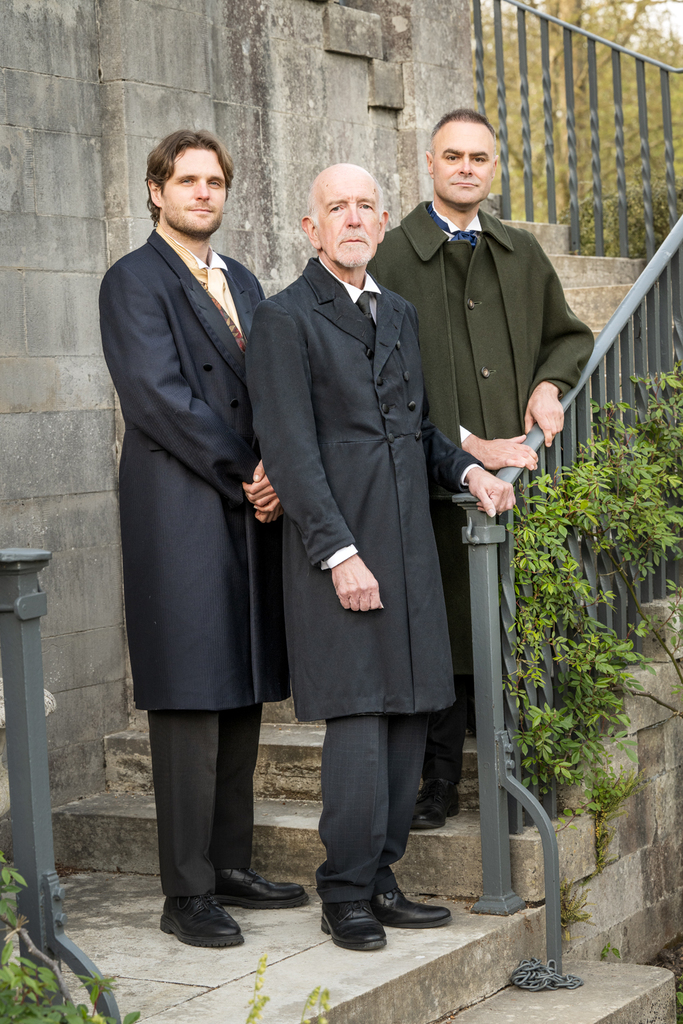
Paul Chalmers was aptly menacing as Count Dracula, while Alistair Faulkner was also fitting in his role as the all-knowing professor Van Helsing. Martha-Rose McKeown and Martha Osment were both incredibly polished and watchable as the petrified victims. Andrew Hall and Matthew Hodge were equally excellent as Dr Seward and Jonathan Harker. A huge mention should go to Simon Haseley, who stole the show at times with his portrayal of the mentally-disturbed Renfield.
The convincingly scary Nosferatu – played by Sheridan Cooper, George Cotterill, Rosie Lewis, Sharon Lloyd, Tasmin Pinder and Fran Sung – were pivotal to the production, gnashing their fangs and swiping claws in the background of each scene.
Linda Hayman has done a magnificent job of directing this slick and well-thought out production.
The creative team, of course, are crucial to the success. White screens and pillars with uplighters were used to create a dark and atmospheric set. While haunting music, ranging from the modern Shadow, by Livingston, to Beethoven’s Piano Sonata No.14 were effectively used to create the chilling ambience.
We are so lucky in Salisbury to have this very gifted theatre company and I urge you all to support their next production of Noises Off in July.
https://www.salisburyjournal.co.uk/news/25192893.studio-theatres-dark-grisly-horror-brilliantly-petrifying/

 Studio Theatre, Ashley Road Salisbury